Hoop Precision Arcade
Reviews
Hoop Precision Arcade strips basketball down to a single decision: which of three baskets to aim for, knowing each success doubles the score and each miss resets it. The roughly sixty-second rounds and clean browser interface suit short breaks, while the local leaderboard adds a reason to improve. It is best for players who enjoy timing-based score attacks and do not need elaborate modes or progression systems.
Description
Three Baskets, One Decision
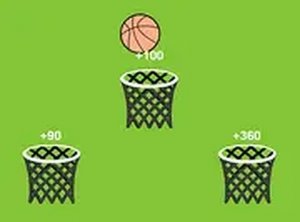
Every shot in Hoop Precision Arcade starts with a choice: which of the three baskets to target. Each hoop carries a different point value, so the highest-scoring option is also the one that demands the most precision. A simple tap or click releases the ball, but the input method is not what makes the game difficult. The challenge lies in reading the shot, committing to a basket, and repeating that motion under time pressure.
The Doubling Multiplier
Scoring works differently from most arcade basketball games. Instead of adding points for each made basket, every successful shot multiplies the current score by two. A single well-placed shot can therefore be worth more than several rushed attempts combined. Missing resets the multiplier, which turns each possession into a risk-reward calculation. Players must weigh the high-value hoop against the safer basket that keeps a streak alive.
Short Rounds and Clean Interface
Rounds are built around a countdown timer, typically around sixty seconds. There are no menus to navigate or tutorials to sit through before playing. The interface stays uncluttered, and full screen mode is available for a larger view. This structure suits quick breaks, and the game runs in any modern web browser without installation.
Leaderboard and Local Tracking
A built-in leaderboard shows how your best scores compare with other players. Scores are saved locally, so personal bests remain visible between sessions even without an account. The leaderboard updates in real time, giving each round a competitive context beyond simple practice. For players who enjoy chasing a number, this adds a reason to refine accuracy rather than just pass the time.










Editorial Notes