Luminous Spire Jump Challenge
Reviews
Luminous Spire Jump Challenge strips platforming down to timing and observation. Each single-screen room asks you to read moving platforms and avoid glowing hazards, with a reset on any mistake. The autosave at every room keeps frustration low and lets you concentrate on one puzzle at a time. The retro neon style and synth soundtrack support the mood without distracting from play. It suits players who enjoy deliberate, repeatable challenges, though those seeking story or variety in mechanics may find it narrow.
Description
Room-by-Room Puzzle Structure
Each room in Luminous Spire Jump Challenge is a single-screen puzzle with a clear goal: reach the exit without touching a glowing hazard. Platforms move on fixed patterns, so the challenge is reading those patterns and timing your jumps accordingly. A single mistake resets the current room, which makes every attempt a clean slate rather than a punishment. Autosave at the start of each new room means you never replay cleared sections. The tower's interconnected rooms are designed to be solved one at a time, and the game expects you to treat each as a separate problem.
Controls and Immediate Feedback
Movement uses arrow keys or WASD for left, right, and jump. The controls are deliberately simple, and the game gives instant visual feedback when you touch a hazard. That clarity matters because success depends on positioning and timing rather than complex inputs. Tight, responsive controls let you make small adjustments mid-jump, which is often the difference between clearing a room and resetting it. The input scheme stays consistent across every room, so difficulty comes from layout and timing, not from learning new buttons.
Difficulty Curve and Progression
Early rooms introduce basic platforming ideas at a forgiving pace. Later rooms demand more precise timing and stronger pattern recognition, gradually increasing the pressure as you climb. The game is built for players who enjoy mastering difficult sections through repetition. Because progress saves automatically, you can focus on one room at a time instead of worrying about losing ground. The difficulty is not about speed alone; it is about observation, patience, and deliberate movement.
Visual and Audio Style
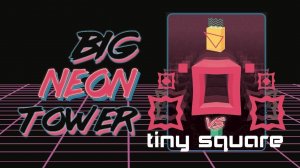
The presentation draws on retro arcade aesthetics. Bright neon colors, glowing lines, and geometric shapes define the look, while a synth-heavy soundtrack supports the atmosphere. The clean, minimal design keeps attention on the platforming challenges rather than distracting from them. The audio builds tension as you progress, matching the increasing difficulty of later rooms. Together, the visuals and sound create a cohesive style that feels nostalgic without being a direct copy of any specific arcade cabinet.
Approaching Each Room
Patience is the most useful habit here. Before moving, watch the layout and the movement patterns of platforms and hazards. Rushing usually leads to a reset, so plan each jump carefully. Repeating a section helps you memorize timing, and the autosave feature lets you concentrate on one room without replaying earlier ones. Staying calm and methodical turns each room into a solvable puzzle rather than a frustrating obstacle.










Editorial Notes