Line Art Cat Rescue Puzzle
Reviews
Line Art Cat Rescue Puzzle turns drawing into a planning exercise: you sketch a path, then watch the cat follow it past walls and moving barriers. The lack of a timer and the freedom to retry make it approachable for children and casual players, while later layouts demand multi-step thinking. Its main limitation is that the challenge rests entirely on path design, so players seeking action or direct control may find it too quiet.
Description
The Drawing-as-Path Mechanic
Your only direct action is drawing a continuous line across the screen. That line becomes a route the cat walks on its own, so the puzzle is not about controlling the cat in real time but about designing a safe path before it moves. The kitten waits at the end of the level, and the cat must reach it without touching a hazard. Because the cat follows the line exactly, a single wrong turn sends it into danger and ends the attempt. Each drawing is therefore a deliberate decision rather than a quick sketch.
Obstacles and Level Layouts
Every stage presents a different arrangement of obstacles. Some are stationary walls; others move in set patterns, so you may need to time the line so the cat passes through a moving gap. Later stages combine these elements in ways that require several steps of planning. The difficulty rises gradually, giving you room to learn how each new element behaves before it is used in a tougher layout. Nothing rushes you, and you can study the whole level before drawing.
Visual Style and Pace
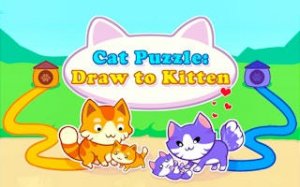
Bright colors and simple shapes keep the screen readable. Cats and kittens are drawn as cute characters with expressive faces, and the backgrounds stay clean so the puzzle elements stand out. Animations are smooth without pulling attention away from the route you are planning. There is no timer and no score pressure, which supports a calm, thoughtful mood even when a level is tricky. [IMG_1]
Progression and Experimentation
As you complete levels, new obstacle types and layouts appear, and the game avoids repeating the same idea. Some stages call for a path that loops back or crosses over itself; others introduce elements that change the environment after the cat starts moving. There is no penalty for retrying, so you can test different line shapes until one works. That trial-and-error process is part of how the game teaches its mechanics.
Who It Suits
The design works for a wide age range. Younger children can enjoy the simple drawing action and the animal theme, while older players get logical challenges that reward planning. Controls are limited to touching and dragging, so no instructions are needed to start. The gentle difficulty curve lets beginners make progress, and later levels offer enough complexity for experienced puzzle players.










Editorial Notes